The days of simply wiring up a schematic, throwing it onto a standard piece of FR-4 fiberglass, and crossing your fingers are officially over (Dead and buried). Today’s technology landscape is entirely unforgiving. If your hardware fails to perform immediately, your competitors will eat your market share for breakfast.
We live in a time dominated by millimeter-wave 5G communications, hyper-connected industrial IoT ecosystems, and edge AI processors that draw massive currents in microsecond bursts. The rules of hardware engineering have fundamentally changed.
The demand for flawless electronics circuit design isn’t just about making a device turn on anymore. On the contrary, it focuses more on ensuring that the device survives and thrives under extreme, unpredictable physical conditions.
The Evolution of Modern Electronics
Think about what actually happens when you cram high-speed digital computing signals directly next to highly sensitive analog RF traces. You get chaotic noise, destructive crosstalk, and a finished product that spectacularly fails its EMC compliance testing.
Modern hardware requires a radical shift away from basic component placement. We are now dealing with highly integrated, densely packaged systems where physics fights you at every turn. When you start pushing operational frequencies into the tens of gigahertz, every single copper trace on your board effectively acts like a microscopic antenna.
| An Expert’s Insight |
| A millimeter of extra trace length can destroy your signal integrity. |
This massive complexity shift is exactly why generic, outdated engineering approaches fail. And it is exactly why specialized electronics designers are now worth their weight in gold.
Defining First-Pass Success
What exactly is first-pass success? Simply put, it means your prototype works flawlessly on the very first manufacturing run. You won’t be dealing with re-spins, agonizing weeks of debugging on a lab bench, or missed product launch windows.
Recent 2025 electronic manufacturing data reveals a harsh reality. While traditional design methods hover around a dismal 60% first-pass success rate, integrating advanced simulation platforms pushes that number to an incredible 95%.
When a single round of prototyping can easily torch $1,000+ in raw manufacturing costs (piled on top of $10,000+ in baseline engineering fees) getting it right the first time isn’t a luxury. It’s the only viable way to protect your R&D budget.
All About The Netiqate Edge
This is precisely where Netiqate steps into the arena. We don’t just connect dots on a screen but also engineer physical solutions (FPGA and AISC circuits) to intensely complex electromagnetic problems. As a premier electronic design consultancy, we close the gap between a theoretical schematic that looks beautiful on a monitor and functional, rugged hardware that survives the real world.
All in all, the team knows exactly how to manage parasitic capacitance, choke out thermal bottlenecks, and stabilize power transients so your product dominates its sector.
Why Technical Complexity Requires an Electronic Design Consultant
You might have a truly brilliant in-house software team. They write flawless firmware. They understand your core product logic perfectly. But when it comes down to the dark arts of high-frequency custom circuit design, software generalists almost always hit a brick wall.
It takes a completely different breed of engineer to predict and control the microscopic chaos happening inside a modern, high-performance printed circuit board.
Schematic Doesn’t Do The Justice!
A schematic merely tells you how things should connect in a perfect, frictionless universe. The physical PCB is the chaotic, noisy reality. Here, an expert electronic design consultant focuses intensely on two critical pillars: Signal Integrity (SI) and Power Integrity (PI).
What happens when a high-speed AI processor switches states in a matter of picoseconds? It demands a sudden, violent gulp of electrical current. If your power delivery network (PDN) isn’t heavily optimized with the exact right decoupling capacitors placed at the exact right physical proximity, your voltage drops instantly. The processor glitches. The system crashes, and that’s the end of the story.
Our engineers map out these transient power demands long before a single copper trace is laid down. We ensure that your signals arrive with clean, wide-open eye diagrams, completely free from destructive signal reflections or timing jitter.
Risk Mitigation
Why wait for a physical board to catch a thermal bottleneck? That’s amateur hour! By the time a physical prototype is sitting in your hands, fixing a major architectural layout flaw means ripping up the entire board and starting from scratch.
Instead, a professional electronic design consultant leverages elite, enterprise-grade simulation environments. Tools like Ansys HFSS and Cadence allow us to build a precise digital twin of your electronics circuit.
We expose this virtual model to brutal thermal cycling, heavy electromagnetic interference, and severe mechanical stress. We literally watch where the heat pools on the silicon. We track exactly where the RF radiation leaks. We fix the failures in the matrix, long before paying for physical fabrication. This predictive approach slashes your R&D risks to near zero.
Industry Standards
Nothing kills a product launch faster than failing regulatory compliance. Imagine spending nine grueling months developing a cutting-edge IoT wearable, only to fail FCC emissions testing by a few microscopic decibels. You are suddenly staring down the barrel of a highly expensive redesign and a catastrophic delay.
Expert electronics design consultants never treat compliance as an afterthought. We design strictly for ISO, CE, and FCC certification from day zero. We implement meticulous grounding strategies, strategic physical shielding, and perfectly balanced layer stack-ups to guarantee that your circuit design sails through third-party compliance labs on the very first try.
The Lifecycle of Professional Custom Circuit Design
Building world-class hardware is not a creative jam session but a highly regimented, violently strict mathematical process. Let’s break down exactly how an elite consultancy takes a rough napkin sketch and transforms it into a high-performance reality.
Phase 1: Architecture & Requirements
You cannot build a skyscraper on a swamp. Phase one is entirely about laying a bulletproof technical foundation. Here, we define the absolute physical limits of the project.
- Power Budgets
How much juice can we legally pull? Are we running off a tiny coin cell battery for ten years, or a massive direct AC line? - Form Factor Constraints
Does this electronics circuit need to fold around a human wrist, or slot into an expansive server rack? - Thermal Ceilings
Where is all the heat going? We map out dense thermal vias and massive heat sink interfaces before selecting a single microchip.
By aggressively defining these harsh constraints upfront, we ensure the design is actually physically possible to manufacture at scale.
Phase 2: Advanced Simulation
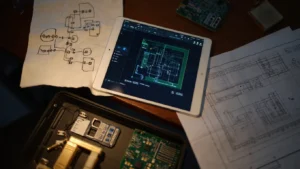
Once the architecture is permanently locked, we move into the virtual proving grounds. This is where high-end EDA (Electronic Design Automation) software does the heavy, expensive lifting.
We use advanced 3D electromagnetic solvers to analyze the exact behavior of high-frequency RF traces. We deeply model the return paths and scrutinize the impedance matching. If there is a hidden parasitic element that threatens to choke your data bandwidth, our simulators will expose it instantly.
| Metric | Traditional R&D Approach | Modern Simulation-Led Approach |
| Methodology | Build hardware, test, find errors, redesign. | Simulate, optimize, verify digitally, build once. |
| Typical Prototype Iterations | 3 to 5 distinct physical spins | 1 to 2 highly optimized spins |
| Financial Impact | Exponentially High ($10k+ wasted per respin) | Highly Controlled, Predictable, and Efficient |
| Time to Market | Delayed by months due to manual debugging | Accelerated, precise, and aggressive |
Phase 3: Prototype and Validation
Simulation is incredibly powerful, but it isn’t the final word. The physical world always has the last say. Once the digital twin passes all operating parameters, we finally transition to physical hardware fabrication.
But we don’t just plug it in and see if the LED lights blink. We execute rigorous, punishing Hardware-in-the-Loop (HIL) testing. We inject raw noise directly into the power lines just to see if the system bucks. We push the data transfer rates completely past their maximum thresholds using Vector Network Analyzers (VNAs) and high-speed oscilloscopes.
We validate our theories against raw, unforgiving reality. When a board passes this phase, it isn’t just functional. It is hardened, reliable, and entirely ready for mass production.
Choosing Between In-House Teams and an Electronic Design Consultancy
Many technology executives eventually grapple with a highly critical business question. Should we hire a full-time, dedicated hardware team, or should we outsource and partner with an electronic design consultancy?
The answer ultimately comes down to sheer scalability and access to deeply specialized expertise.
The Scalability Dilemma Is Real
Maintaining a top-tier team of dedicated hardware engineers is staggeringly expensive. You are not just paying high-end six-figure salaries but also accounting for continuous corporate training, expansive healthcare benefits, and massive, recurring software licenses.
Furthermore, hardware development typically comes in intense, violent waves. You might desperately need six senior RF engineers for a brutal four-month sprint to get a prototype out the door, and then need absolutely none of them for the following year while your software team writes the firmware. An electronic design consultant gives you immediate, on-demand access to elite talent exactly when you need it. And zero overhead when you don’t.
Access to High-End Tech
Let’s talk briefly about the tools of the trade. Enterprise-level EDA software (the specific kind required to simulate dense, high-speed multi-layer boards accurately) can easily cost upwards of $50,000 to $100,000 per seat, per year. For a startup or even a rapidly growing mid-sized enterprise, that is a crippling capital expense to swallow.
By strategically partnering with a specialized consultancy, you instantly tap into this million-dollar software ecosystem without spending a single dime on licensing fees. We bring the heavy artillery directly to your project, allowing your working capital to stay focused exactly where it belongs: on marketing, sales, and scaling inventory.
Accelerated Speed to Market
Time is the ultimate currency in the technology sector. If you are paying an internal team to learn the incredibly nuanced details of 6G antenna integration on the fly, you are bleeding time. Your competitors are absolutely not waiting for you to catch up.
Experienced electronics designers have seen it all. We have successfully built hundreds of complex boards. We know the exact manufacturing loopholes. We have deep, existing relationships with global fabrication houses in Taiwan, China, and North America. We know exactly which specific microcontrollers are currently facing 50-week supply chain shortages, and we know exactly which alternative drop-in replacements to use instead.
This level of entrenched, battle-tested industry knowledge easily shaves critical months off a product’s overall development cycle. It transforms your hardware development phase from a massive, unpredictable bottleneck into a streamlined, highly lethal competitive advantage.
Emerging Trends Handled by Top Electronics Designers
The technological baseline is moving at a breakneck pace. What was considered cutting-edge just three years ago is now the bare minimum standard for consumer electronics. To survive the brutal hardware market of 2026, companies have to look ahead. They need to anticipate the physical demands of tomorrow’s infrastructure.
This is where our elite electronics designers earn their keep. We architect systems capable of handling the extreme, bordering-on-sci-fi trends dominating the current decade.
Miniaturization: Shrinking the Unshrinkable
Consumers want more processing power. They want larger batteries. And ironically, they want the physical device to be thinner and lighter than ever before. This paradox is driving the push toward extreme miniaturization in both aerospace engineering and consumer wearables.
You can’t just cram components closer together. When you reduce the physical footprint of an electronics circuit, heat density skyrockets. Cross-talk between adjacent communication traces becomes a nightmare. To combat this, a seasoned electronic design consultant deploys advanced High-Density Interconnect (HDI) strategies.
| Why Netiqate Stands Out |
| We use microscopic blind and buried vias. We leverage rigid-flex PCB designs that allow the motherboard to literally fold around the contours of a drone chassis or a smart ring. Also, the team works with impossibly small 01005 passive components that look like literal specks of dust to the naked eye. |

RF and Microwave Integration Are The 6G Frontier
5G changed the game, but 6G and the massive explosion of Low Earth Orbit (LEO) satellite communications are entirely rewriting the physics rulebook. We are no longer just pushing megahertz. We are pushing deep into the sub-terahertz frequency bands.
Why FR-4 Circuits Are No Longer Ideal?
At these ultra-high frequencies, standard FR-4 circuit board material is practically useless. It absorbs your signals like a wet sponge. The dielectric loss is catastrophic. High-frequency circuit design demands exotic substrate materials like Rogers or Teflon. It requires engineers who can visualize how a signal wave travels not just through a copper trace, but along the surface of it due to the skin effect.
A premier electronic design consultancy tackles these RF and microwave challenges head-on. We design intricate phased-array MIMO antennas directly into the PCB layer stack. We isolate sensitive analog receiver chains from noisy, aggressive digital processors using physical moats of copper shielding. If your hardware is going to communicate with a satellite traveling 17,000 miles per hour, your RF layout has to be mathematically flawless.
Ready to choose the right hardware architecture? Contact us today.
Sustainability and Efficiency
Energy efficiency is no longer just a marketing buzzword but a strict operational mandate. Modern electronics design consultants are obsessed with optimizing the power envelope. We are aggressively moving away from legacy silicon and integrating Wide Bandgap (WBG) semiconductors like Gallium Nitride (GaN) and Silicon Carbide (SiC).
That’s because all of them switch incredibly fast and generate a fraction of the heat, drastically improving the efficiency of high-power solar inverters and battery management systems.
For low-power IoT devices, we engineer aggressive sleep-state protocols. We design deep-sleep circuitry that draws mere nano-amps of quiescent current, waking up only for microseconds to transmit data via BLE 6.0 before shutting back down.
This penny-pinching approach to power consumption is exactly how we squeeze ten years of battery life out of a single coin cell.
The Bottom Line
Let’s wrap this up with a dose of pure reality. Hardware is hard, unforgiving, heavily regulated, and violently expensive if you get it wrong. But when executed correctly? Hardware is the ultimate defensive moat.
Your initial approach to custom circuit design dictates the entire financial trajectory of your project. If you try to cut corners with cheap layouts and bypass deep electromagnetic simulation, you will pay for it tenfold in delayed launches, ruined manufacturing runs, and massive recall campaigns.
Collaborating with top-tier electronics design consultants is the only reliable way to future-proof your R&D pipeline. So, stop viewing your physical hardware development as a terrifying bottleneck. Treat it as your strongest competitive advantage by partnering with a specialized electronic design consultancy like Netiqate.
Frequently Asked Questions (FAQs)
What is the primary benefit of First-Pass Success in high-performance electronics?
First-pass success means your initial physical prototype works flawlessly right off the assembly line. Every time a prototype fails, you are forced into a “re-spin.”
A single board re-spin involves tracking down the bug, re-routing the custom circuit design, ordering new fabrication, sourcing new components, and waiting weeks for assembly. Achieving first-pass success bypasses this entirely, preserving your R&D budget.
How does an electronic design consultant reduce R&D risks compared to in-house generalists?
In-house generalists are often jacks of all trades. They might know a little about firmware, a little about basic wiring, and a little about mechanical enclosures. But high-speed electronics require deep, hyper-specialized mastery.
An electronic design consultant acts as a targeted specialist. We focus entirely on edge-case physics, including signal integrity, parasitic capacitance, thermal dissipation, and electromagnetic interference.
What role does simulation play in reducing the cost of custom circuit design?
Simulation is the ultimate financial safety net. It allows engineers to build a perfectly accurate digital twin of your electronics circuit. Instead of paying a fabrication house $5,000 to print a physical board just to see if it overheats, we expose the digital twin to virtual stress tests using enterprise software. We can test how the board handles sudden voltage spikes, extreme temperature fluctuations, and aggressive RF noise.
How do you ensure a design meets international compliance standards (FCC/CE) before manufacturing?
You cannot add compliance to a finished product. It has to be baked into the very DNA of the board layout from day one. Professional electronics designers ensure compliance through aggressive, upfront mitigation strategies. We use massive, unbroken internal ground planes to absorb stray RF energy. The team also uses strategic via-stitching to contain electromagnetic fields around noisy clock signals.