Think about the last time you were at a packed stadium or a sold-out concert. You pull out your phone to send a quick video. With 4G, that progress bar would freeze. Your phone had full bars, but the network was choked. It was like thousands of people trying to order a drink from a single bartender at the same time.
Then 5G arrived. Suddenly, you can stream 4K video from row Z of a 100,000-seat arena without a single buffer. That’s not magic, it’s physics, incredibly complex math, and a brilliant piece of hardware engineering known as MIMO.
If you want to understand why 5G is fundamentally different from every generation of wireless tech that came before it, you have to look at the antennas. We aren’t just shouting louder anymore. We are shouting smarter. Let’s tear apart the technology making this possible.
Why We Couldn’t Just Build a Bigger Antenna
Before we jump into the deep end of 5G, we need to understand the physical limits of radio frequencies (RF).
For decades, cellular networks operated mostly on the “SISO” model. This is an abbreviation of Single Input, Single Output. One antenna on the cell tower transmits, and one antenna inside your old flip phone receives. If the signal got weak, engineers just cranked up the power. If the network got congested, they bought more spectrum.
But the spectrum is finite and expensive. Billions of dollars are spent at government auctions just for a few megahertz of invisible real estate. According to the Shannon-Hartley theorem, there is a hard mathematical limit to how much data you can stuff into a specific slice of the spectrum. We hit a wall. To get gigabit speeds, we had to change the shape of the signal itself.
Decoding the Acronym: What is MIMO?
MIMO stands for Multiple Input, Multiple Output. It is considered a much better alternative to microwave design circuits. Instead of a single antenna doing all the talking and listening, a MIMO system uses multiple antennas at both the transmitter (the cell tower) and the receiver (your smartphone).
The Core Concept:
By sending multiple data streams simultaneously over the same frequency, you multiply the capacity of the network without needing extra spectrum.
But the spectrum is finite and expensive. Billions of dollars are spent at government auctions just for a few megahertz of invisible real estate. According to the Shannon-Hartley theorem, there is a hard mathematical limit to how much data you can stuff into a specific slice of the spectrum. We hit a wall. To get gigabit speeds, we had to change the shape of the signal itself.
Decoding the Acronym: What is MIMO?
MIMO stands for Multiple Input, Multiple Output. It is considered a much better alternative to microwave design circuits. Instead of a single antenna doing all the talking and listening, a MIMO system uses multiple antennas at both the transmitter (the cell tower) and the receiver (your smartphone).
The Core Concept:
By sending multiple data streams simultaneously over the same frequency, you multiply the capacity of the network without needing extra spectrum.
Here is how the evolution breaks down:
| Technology | Antennas (Tx / Rx) | How it Works | Analogy |
| SISO | 1 / 1 | One stream of data. Highly susceptible to interference. | A single-lane dirt road. |
| SIMO | 1 / Multiple | The receiver has multiple antennas to catch the best signal. Improves reliability. | A single-lane road opens into a massive parking lot. |
| MIMO (4G) | 2×2 or 4×4 | Multiple data streams are sent simultaneously. Speeds double or quadruple. | A four-lane highway. |
| Massive MIMO (5G) | Up to 64×64 | Dozens of antennas actively tracking users and shaping signals. | A dynamically shifting, multi-level flying highway system. |
The Multi-Path Glitch That Became a Feature
To truly grasp how MIMO works, you have to understand multipath propagation. When a cell tower blasts a radio wave, it doesn’t just travel in a straight line to your phone. It bounces, reflects off glass skyscrapers, scatters through trees, and diffracts around concrete corners.
In the early days of wireless communication, multipath was a nightmare. The bounced signals would arrive at the phone fractions of a microsecond after the direct signal. This created “destructive interference,” garbling the data. Engineers fought for decades to filter out these echoes.
MIMO Antennas Changed The Game Once And For All
Unlike other antenna design services, MIMO flipped the script. It took the enemy and made it the engine. Because a MIMO tower has multiple antennas spaced slightly apart, each antenna receives those bounced signals at a slightly different microscopic time and angle. The heavy lifting is done by the tower’s baseband processors, which use complex matrix mathematics to untangle these arriving signals.
Instead of seeing the bounced signals as noise, MIMO maps the distinct physical path each reflection took. These unique paths are called spatial signatures. Once the system knows the exact physical environment between the tower and your phone, it can exploit it using two groundbreaking techniques:
- Spatial Multiplexing
- Beamforming
Spatial Multiplexing:
This is where the real speed boost happens. Imagine you need to send a massive 10GB file. If you only have one antenna, you have to send it sequentially: Packet A, then Packet B, then Packet C.
If you have a 4×4 MIMO setup (four transmit, four receive), the tower chops that 10GB file into four separate pieces. It sends all four pieces at the exact same time, on the exact same frequency.
How Do They Not Crash Into Each Other?
Because the tower intentionally fires them at different objects in the environment. It might shoot stream A directly at you, bounce stream B off the building to your left, bounce stream C off the pavement, and bounce stream D off a parked bus. Because your phone has four antennas, and each antenna is listening for a specific spatial signature, it catches all four streams simultaneously and stitches the file back together.
You just quadrupled your download speed without using a single extra hertz of spectrum. It’s a mind-bending feat of real-time geometry.
Enter 5G: The Massive MIMO Upgrade
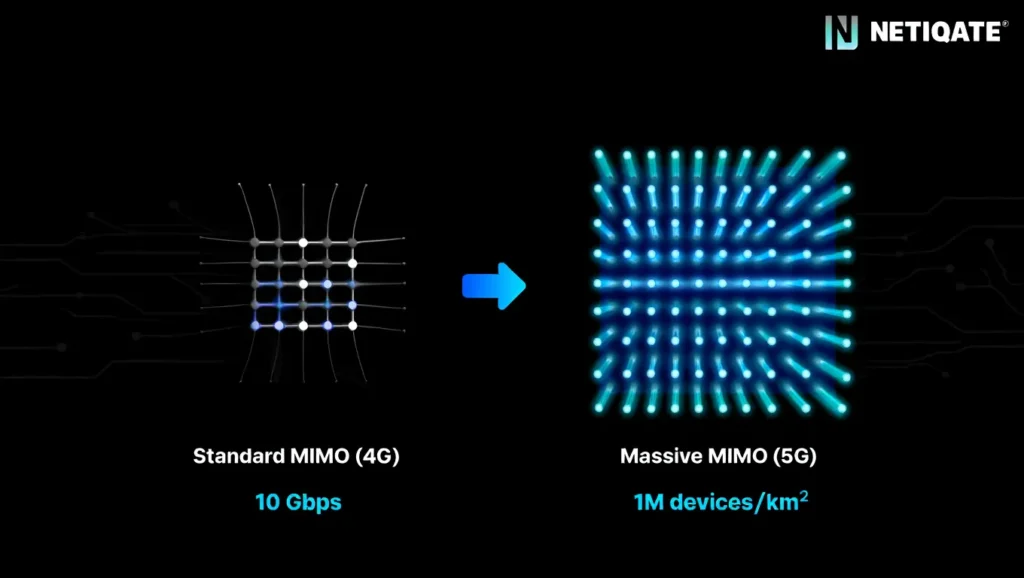
Standard MIMO was great for 4G. But 5G promised speeds up to 10 Gbps and the ability to connect a million devices per square kilometer. A 4×4 antenna wasn’t going to cut it.
Welcome to Massive MIMO. When we say massive, we aren’t talking about physical size. We are talking about the sheer volume of antenna elements crammed into a single panel.
| Important Note |
| A typical 5G Massive MIMO base station uses a 64T64R configuration. That means 64 transmit antennas and 64 receive antennas working in absolute unison. (Some advanced configurations are even pushing 128 or 256 elements) |
This leap in hardware density enables the network to handle extreme traffic loads. But dumping 64 antennas onto a tower creates a massive problem: interference. If 64 antennas just blast radio waves in all directions, it creates a chaotic soup of radio frequency noise. Nobody gets a signal.
To solve this, Massive MIMO relies on its secret weapon.
Beamforming
Traditional cell towers are like bare lightbulbs. Turn them on, and they illuminate everything in a 120-degree arc. Whether you are standing directly under the tower or a mile away, the tower is wasting enormous amounts of energy blasting the sky, empty fields, and buildings with radio waves just to ensure your phone catches a tiny fraction of it.
Massive MIMO base stations act more like laser pointers. This is Beamforming.
Instead of a wide, dumb broadcast, the 64 tiny antennas inside the Massive MIMO panel work together to sculpt the radio signal into a tight, focused, invisible beam of data aimed directly at your specific smartphone. As you walk down the street, that invisible beam physically tracks you.
How Does A Stationary Tower Physically Move A Beam Without Moving Parts?
Phased Arrays and Constructive Interference. It’s all about timing. The 64 antennas emit the exact same signal, but the computer delays the transmission on certain antennas by mere picoseconds (trillionths of a second).
By carefully staggering when the signal leaves each tiny antenna, the radio waves crash into each other in mid-air. Where the peaks of the waves align, they amplify each other (constructive interference). Where a peak meets a trough, they cancel each other out (destructive interference).
By shifting the phases dynamically, the cell tower literally shapes the energy into a narrow cone and electronically steers it left, right, up, or down.
The Real-World Impact of Beamforming
- Insane Efficiency: Because the energy isn’t wasted illuminating a whole neighborhood, the signal hitting your phone is incredibly strong and clean.
- Eliminated Cross-Talk: The tower can simultaneously shoot one beam to you, and completely different beams to five other people standing just a few feet away, entirely on the same frequency, without the signals interfering with each other.
- Overcoming mmWave Limits: 5G relies heavily on high-frequency “millimeter wave” (mmWave) spectrum for its fastest speeds. The problem? mmWave signals are notoriously weak; they can be blocked by a wet leaf or your own hand. Beamforming focuses these fragile waves into a dense enough cluster to punch through obstacles and reach your device.
Multi-User MIMO (MU-MIMO): The Ultimate Party Trick
In 4G, MIMO was mostly Single-User (SU-MIMO). The tower would focus its resources on one device at a time, switching between them so fast you didn’t notice. But in a 5G world filled with IoT sensors, smartwatches, and high-speed handsets, “switching” creates a bottleneck.
Multi-User MIMO (MU-MIMO) allows a 5G base station to communicate with multiple independent devices simultaneously using the same frequency coordinates.
How is this physically possible? It comes down to Spatial Separation.
Imagine a room where five people are talking at once. Normally, it’s a roar of noise. But with MU-MIMO, the tower creates “null zones.” While it targets a high-power beam at User A, it simultaneously calculates a “zero-signal” pattern for that same beam at the exact physical coordinates of User B.
The Result:
User B’s phone “hears” absolutely nothing from User A’s data stream, even though they are standing three feet apart. The tower manages dozens of these “spatial layers” at once. It’s like having twenty private conversations in a library without anyone overhearing a single word.
| Feature | SU-MIMO (Single User) | MU-MIMO (Multi-User) |
|---|---|---|
| Connectivity | Sequential (one by one) | Concurrent (all at once) |
| Efficiency | Moderate; idle time between swaps | Maximum; fills every “spatial hole” |
| Latency | Higher (wait times) | Ultra-low (instant access) |
| Device Load | Best for single high-speed downloads | Best for crowded stadiums/cities |
The Millimeter Wave (mmWave) Challenge
We cannot discuss 5G MIMO without addressing the “elephant in the room”: high-frequency waves.
5G operates across three layers: Low-band (under 1 GHz), Mid-band (3–6 GHz), and High-band (24–100 GHz). That high-band, known as mmWave, is where the 10 Gbps speeds live. But these waves are fragile. They are so small (literally millimeters long) that they cannot penetrate walls, windows, or sometimes even heavy rain.
Massive MIMO is the only reason mmWave is viable.
Because the antennas are so small (proportional to the wavelength), we can pack hundreds of them into a panel the size of a laptop. This massive antenna gain acts like a magnifying glass for a flashlight. It takes a weak, easily blocked signal and focuses it into a high-energy “pencil beam” that can bounce off a building and still reach your phone with enough integrity to deliver a gigabit of data.
Ready to choose the right hardware architecture? Contact us today.
The Hardware Teardown: What’s Inside the Box?
If you were to crack open a 5G Massive MIMO unit (an Active Antenna Unit or AAU), you wouldn’t just see wire. You’d find a masterpiece of integrated circuitry.
- The Radiating Elements: Usually cross-polarized “dipoles.” These are the physical bits that vibrate with electrons to create the waves.
- The Phase Shifters: These are the “steering wheels.” They adjust the delay of the signal to each antenna to move the beam.
- The Power Amplifiers (PAs): Because 5G uses higher frequencies, the signal dies out quickly. Tiny, highly efficient Gallium Nitride (GaN) amplifiers are placed right next to each antenna element to boost the signal before it hits the air.
- The Baseband Processor: Digital Processing Design circuits perform billions of Fast Fourier Transforms (FFTs) every second to calculate how to untangle the incoming signals.
Real-World Benefits: Why Should You Care?
It’s easy to get lost in the “math” of it all, but the impact of Massive MIMO on human life is tangible.
1. Fixed Wireless Access (FWA)
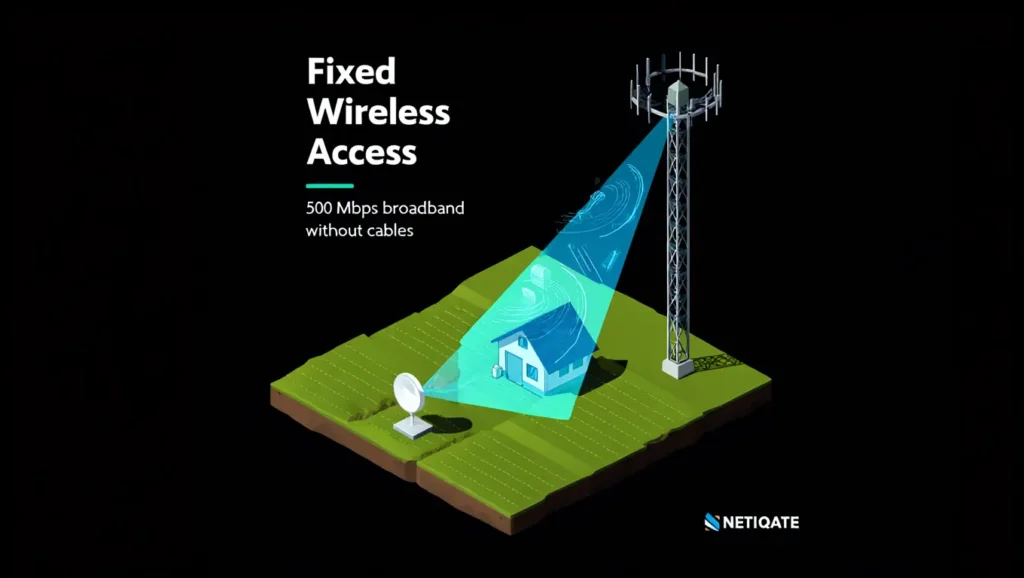
Massive MIMO allows 5G to replace fiber-optic cables in the ground. Because the tower can beam a dedicated, high-speed connection directly to a “fixed” receiver on your house, people in rural areas can finally get 500 Mbps internet without a company digging a multi-million dollar trench to their door.
2. Massive IoT
In a smart city, everything from trash cans to streetlights needs a connection. Massive MIMO’s ability to manage hundreds of simultaneous spatial streams means the network won’t crash when ten thousand “smart” devices in a single city block try to check in at once.
3. Lower Battery Drain
Wait, do more antennas use less battery? Counter-intuitively, yes. Because the tower is “finding” your phone and aiming a concentrated beam at it, your phone’s internal radio doesn’t have to work as hard to “scream” back at the tower. The SNR (Signal-to-Noise Ratio) is so much better that your phone can drop its transmission power, saving your battery life.
The Future
We are already looking toward the 2030s. If 5G is “Massive” MIMO, 6G is looking at Ultra-Massive MIMO (UM-MIMO).
We are talking about thousands of antenna elements integrated into the very fabric of buildings, essentially “intelligent surfaces.” Imagine a wall painted with a special conductive paint that acts as a giant antenna, reflecting and focusing signals to eliminate “dead zones” entirely. The math will get harder, the speeds will hit 100 Gbps, but the core principle of spatial multiplexing remains the king of the hill.
Frequently Asked Questions (FAQ)
Does Massive MIMO cause more radiation?
Actually, it’s more targeted. Traditional towers broadcast 360 degrees constantly. Massive MIMO only sends energy toward the devices that are actually using it. The total RF exposure in many areas actually drops because the energy is concentrated rather than sprayed everywhere.
Why does my 5G still slow down sometimes?
Massive MIMO is a tool, but it’s limited by backhaul. If the cell tower is connected to the internet via a slow fiber-optic cable, it doesn’t matter how fast the “air” part of the connection is. You’re only as fast as the weakest link.
Does rain affect 5G MIMO?
For Sub-6 (mid-band) frequencies, no. For mmWave (high-band), yes. Water molecules absorb high-frequency radio waves. However, Massive MIMO helps mitigate this by using beamforming to find the path of least resistance or by increasing the “gain” to punch through the weather.
Can old phones use Massive MIMO?
A 4G phone can benefit from the capacity improvements of a Massive MIMO tower (less congestion), but it lacks the hardware to utilize the spatial multiplexing or beamforming features of 5G. You need a 5G-enabled modem (like the Snapdragon X-series) to join the party.
Conclusion:
Massive MIMO is the unsung hero of the modern digital age. It is the technology that took a crowded, noisy, and limited radio spectrum and turned it into a high-definition, multi-layered digital highway.
By utilizing the physics of interference to our advantage (turning “echoes” into data streams and “noise” into signals), engineers have effectively broken the limits of the Shannon-Hartley theorem. We are no longer just sending bits through the air; we are surgically delivering data to the palm of your hand, across a crowded city, at the speed of light.
As we move toward an era of augmented reality, autonomous vehicles, and remote robotic surgery, the invisible dance of 64 antennas on a pole will be the heartbeat of it all. The next time you see a 5G panel on a rooftop, don’t just see a piece of grey plastic. See a mathematical masterpiece.