The technology of modernity is reliant on advanced chips. High-performance hardware architecture is required in systems like AI platforms, autonomous vehicles, and telecommunication networks to be able to process information in a faster and superior manner. This requirement renders the FPGA vs ASIC controversy highly significant in today’s semiconductor design.
Engineers often compare these two technologies when building high-performance systems. FPGAs are flexible in the sense that they can be reprogrammed by the developers even after the manufacturing process. As compared, the ASIC chips provide specialized tasks with optimized performance and increased power efficiency.
Cost, speed, and scalability are also affected by this choice. Actually, the FPGA and ASIC markets arou
nd the world are expected not only to hit approximately 34.5 billion by 2024 but also to rise to 67.8 billion in 2032. This is the rapid development of the importance of specialized hardware.
What architecture do you want? The comparison of FPGA vs ASIC will help you to select the right solution for your project.
What is an FPGA?
So what is an FPGA? The FPGA is a programmable hardware card on which engineers can modify after it has been shipped to the factory. The chip can be programmed by the developers to execute various digital tasks depending on the project specifications. This adaptability makes FPGA devices applicable in most of the contemporary systems.
The FPGA architecture consists of a number of components. Processing of digital logic operations is done using Configurable Logic Blocks (CLBs). It also performs logical functions through Lookup Tables (LUTs). Further on, a routing interconnect network is added that connects these blocks and transfers signals throughout the chip. Most of the FPGAs also come with DSP blocks that perform complex computations and signal processing.
Due to such reconfigurated hardware, engineers are able to upgrade or update the design without changing the chip. Consequently, FPGA devices are deployed in aerospace systems, 5G telecommunications equipment, and machine vision.
What is ASIC (Application Specific Integrated Circuit)?
Now we will know what an ASIC chip is. An ASIC (Application Specific Integrated Circuit) is a specialized integrated circuit that is used to carry out one task. Engineers design this chip in such a way that it can do a specific task in the most efficient way possible. An ASIC cannot be changed after fabrication, as is the case with programmable hardware.
Software developers concentrate on the ASIC hardware design to maximize performance and power consumption. The chip is constructed with a transistor-level design, and this enables control of logic and circuitry to a very small degree. Consequently, ASIC solutions have higher speeds and consume less power than flexible solutions.
Since ASIC chips offer fixed functionality, the companies apply them in systems where high performance and stability in processing are needed. As an example, iPhones are powered by Apple A-series processors and are known to perform some sophisticated mobile computing functions. Equally, Google TPU artificial intelligence chips are used to speed up machine-learning tasks in data centers. Moreover, advanced driver assistance systems and vehicle electronics are based on many automotive safety chips that use ASIC technology.
FPGA vs ASIC: Key Differences Explained
The selection of chip architecture influences the performance, cost, and scalability. As such, FPGA vs ASIC differences are frequently studied by engineers before the commencement of a hardware project. The two technologies are used to drive contemporary electronic systems, but they have their applications. Knowledge of this ASIC vs FPGA comparison may enable developers to make the appropriate choice regarding the solution to the design.
Flexibility and Design Adaptability
One of the largest differences between these architectures is made by flexibility. The FPGAs offer reconfigurable hardware, and that is to say that the design can still be adjusted by the engineers after it is deployed. The ability has led developers to use FPGA devices in prototyping and systems that need updates.
Conversely, ASIC chips follow a given design. They are constructed by engineers to serve a single purpose. Once the design is made, it becomes impossible to alter it. Nevertheless, such specialization enables the ASIC chips to give enhanced performance.
Development Time
The speed of development is also significant in hardware projects. The FPGA solutions enhance the rapid development processes since the engineers are able to program and test the design on the chip.
Conversely, the development of ASIC takes longer. Design of the ASIC hardware should be done in detail, verified and fabricated by engineers, and finally, the chip should be manufactured.
Power Efficiency and Performance
Many of the modern systems, mostly AI and mobile devices, are highly affected by power efficiency. ASIC chips tend to be less power-consuming as engineers are able to optimize the circuit down to the transistor level. The consequence is that the ASIC technology provides enhanced energy efficiency.
FPGAs, on the other hand, contain programmable logic and routing networks. They make it more flexible and more power-consuming. Thus, the performance of an FPGA can be rather average in comparison with high-performance ASIC-based chips.
Cost and Production Scale
Cost is also dependent on the volume of production. FPGA devices are also suitable when production is not in large numbers, since it does not need costly fabrication equipment. They can be deployed in a short time without a high start-up cost.
ASIC chips are very expensive to develop, but they lower the unit cost in large-scale manufacturing. Due to this advantage, consumer electronics and high-volume products are frequently being used with ASIC technology by companies.
FPGA vs ASIC Comparison
| Feature | FPGA | ASIC |
| Flexibility | Reprogrammable | Fixed design |
| Development Time | Faster | Longer |
| Power Efficiency | Higher power use | Lower power use |
| Unit Cost | Higher | Lower at scale |
| Performance | Moderate | Very high |
FPGA vs ASIC Architecture Comparison
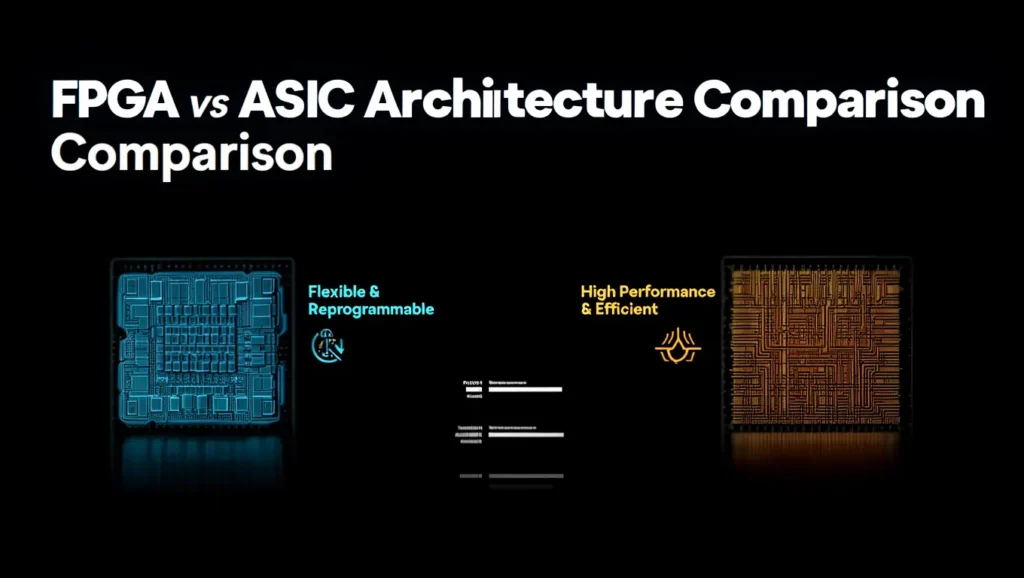
Learning the architecture of FPGA and ASIC can also assist an engineer in selecting the appropriate chip to use in their project. It is different between the two architectures, with an impact on the flexibility, performance, and power efficiency. An explicit look at their constituents indicates the reason behind the success of each of the technologies in various uses.
Logic Units
FPGAs use Lookup Tables (LUTs) as their basic logic units. The engineers can reconfigure and program these LUTs with ease. By contrast, ASICs make use of standard cells, fixed logic circuits that are optimized for particular functions. This renders ASICs more efficient and speedy in special work.
Routing
Routing defines the movement of signals in the chip. FPGAs are based on programmable routing networks. This can be modified to enable the developers to test the designs and make adjustments once they are manufactured. ASICs, however, have fixed metal routing which is pre-designed and is much more performance and energy efficient.
Memory
Memory blocks differ as well. FPGAs have BRAM blocks (Block RAM) that are used to store temporary data and also to access them rapidly during computing. It is commonly a custom SRAM that is specific to the task of the chip and is much more efficient and consumes less power.
DSP Blocks
In mathematical operations, FPGAs are provided with embedded DSP blocks, which can deal with workloads such as signal processing or AI calculations. ASICs exploit specially designed DSP circuits, configured to the specific load to be primarily speedy and efficient.
Architecture Comparison
| Component | FPGA | ASIC |
| Logic Units | LUTs | Standard cells |
| Routing | Programmable routing | Fixed metal routing |
| Memory | BRAM blocks | Custom SRAM |
| DSP Blocks | Built-in | Custom designed |
Performance Comparison: FPGA vs ASIC
The performance difference between FPGA and ASIC is obvious. ASIC chips present significantly faster throughput since they are hardware optimized. They can work on parallel processing and execute at faster clock speeds. In one example, ASIC accelerators can easily hit 33% high throughput with neural-network workloads compared to FPGA implementations.
That is why ASICs are perfect in the field of AI inference accelerators and other performance-intensive applications. FPGAs continue to be very good, but their reconfigurable logic is a minor speed constraint to specialised ASIC circuits.
Power Consumption Comparison
The other important aspect of the FPGA vs ASIC power consumption battle is power efficiency. Asics use transistor optimization to minimize energy usage, whereas FPGAs use programmable logic overheads to consume more energy. Research indicates that ASICs can use up to 46% of the power of FPGA implementation of the same artificial intelligence workloads.
In this case, it will be useful to include a power consumption bar chart that will allow the readers to visualize the energy efficiency advantage of ASICs over FPGAs.
Development Time and Design Flow
There is a major difference between the FPGA design flow and the ASIC development process. FPGAs can be prototyped at blistering speed since engineers can program the chip at all. The longer part of ASICs is the tape-out and fabrication.
| Stage | FPGA | ASIC |
| RTL Design | Yes | Yes |
| Synthesis | Yes | Yes |
| Place and Route | Yes | Yes |
| Bitstream Generation | Yes | No |
| Tape-out | No | Yes |
| Fabrication | No | Yes |
The knowledge of such stages assists engineers in planning projects depending on the time-to-market and complexity.
Cost Comparison: FPGA vs ASIC
One of the key factors to consider during the selection of hardware is cost. FPGAs have no initial fabrication cost (NRE), but increased unit cost. ASICs have a cost of $1M to 10M of NRE, but a lower unit cost at high volume.
| Cost Factor | FPGA | ASIC |
| NRE Cost | $0 | $1M – $10M |
| Unit Cost | $20 – $200 | $1 – $10 |
| Best for Volume | Low volume | High volume |
The engineers will have to balance the cost of development, the cost of manufacturing, and the quantity of production to choose the cheapest way out.
Ready to choose the right hardware architecture? Contact us today.
FPGA vs ASIC: Which Hardware Architecture Should You Choose?
A project can be broken or made by the choice of the hardware architecture. A decision in the hardware architecture can fracture or construct a project. The problem of FPGA vs ASIC is a problem that engineers will always face as they come up with systems to be used in AI, telecom, automotive and industrial applications. Both technologies are beneficial in their own way and the right one will depend on the needs of your project.
Why Does Choice Matters?
The decision that can be made between the FPGA and ASIC affects performance, flexibility, power efficiency, and cost. The incorrect decision may make the development more time-consuming, use more energy, and cost more to make. Knowledge of differences makes you have an efficient system with respect to its goals.
FPGA: Flexibility and Fast Development
FPGAs have programmable hardware that can be modified even after fabrication by engineers. This makes them ideal for:
- Prototyping hardware
- Low-volume production
- Projects requiring frequent updates
- Shorter time to market
ASIC: High Performance and Efficiency
ASICs are chips that are designed to perform definite tasks. They provide optimal performance, reduced power use, and efficiency. Use ASICs when:
- Mass production is required
- High performance is critical
- Low power consumption is needed
- Hardware design is stable
How to Decide?
Through the analysis of architecture, performance, power, cost, and applications, the engineers will be able to select the appropriate hardware to use in their project. FPGAs are more suitable for flexible and dynamic IC designs, whereas ASICs are suitable for systems that are high-volume and high-performance.
The guide provides ample background to compare FPGA vs ASIC and make a sound choice of hardware.
Real-World Applications of FPGA and ASIC
Knowing the application of FPGA and ASIC in actual systems assists the engineers in making more choices. The two technologies are used to power critical applications in industries, but they are used to serve very different needs.
FPGA Applications
FPGAs are quite effective in systems that are demanding flexibility and reconfigurability. For example, aerospace systems use FPGAs for radar signal processing and satellite communications. Defense electronics are based on FPGAs that provide reliable and flexible operations. FPGAs are used to control high-speed data traffic in telecom base stations. They are also good at automating industries to make robotics and machinery react instantly.
ASIC Applications
ASIC chips provide the optimum performance for fixed work. ASICs are used in smartphone processors, such as those of the A-series of Apple, to execute sophisticated mobile applications using very little power. The use of AI accelerators is based on ASICs to perform neural-network calculations more rapidly.
ASIC chips are also essential in cryptocurrency mining equipment that its developers require to achieve the highest hash-rate performance. Moreover, automotive safety systems adopt an automotive system on a chip to provide real-time and reliable operation of driver-assist features.
When Should You Choose an FPGA?
When to use an FPGA is a choice that will help you to save time and expenses in your project. FPGAs are more efficient in cases where flexibility and rapid implementation are required.
You are supposed to think about an FPGA when:
You should consider an FPGA when:
- Prototyping hardware: Design Test and refine your design for full production.
- Low production volume: do not want high fabrication costs to run small production volumes.
- Frequent updates required: The hardware is modified rapidly as the needs change.
- Shorter time to market: implement solutions in a shorter time through programmable logic.
FPGAs provide engineers with the freedom of experimentation, iteration, and modification of designs effectively. This is why they are best suited to dynamic systems applications such as artificial intelligence testing, telecom prototyping, and industrial automation systems.
When Should You Choose ASIC?
You can know when to use ASIC to ensure that you have high performance and efficiency in your project. ASICs are good in the areas that require consistency and capability.
ASIC should be considered in the following situations:
- High production volume: lowers the price per unit of mass production.
- High performance required: maximize speed and processing to achieve heavy workloads.
- Low power consumption is needed: conserve energy through transistor-level efficiency.
- Stable hardware design: use fixed-purpose chips that are not changed regularly.
ASICs are perfect in smartphones, AI accelerators, automotive safety systems, and cryptocurrency mining devices. They provide unrivaled performance and reliability when used in large-scale or performance-intensive use.
FPGA vs ASIC Decision
It can be difficult to make the correct decision between an FPGA and an ASIC. This guide of decisions makes it easier. Do it to align your project needs with the optimum hardware. It is also an active section that serves as a BOFU conversion stage, thus assisting the reader in making actionable decisions.
| Project Requirement | Recommended Technology |
| Prototype design | FPGA |
| Low volume | FPGA |
| Mass production | ASIC |
| Power efficiency | ASIC |
| Flexible hardware | FPGA |
Future Trends in FPGA and ASIC Technologies
The FPGA and ASIC technologies have a bright future. The development of new trends is influencing the design and deployment of chips among engineers.
AI Accelerators
AI is now being powered by ASIC and FPGA chips. Neural network speed, parallel processing, and inference are enhanced by the use of AI accelerators.
Edge Computing
There is a need for low-latency processing of edge devices. FPGAs and ASICs assist in executing computations that are closer to data sources, which become efficient and fast-reactive.
Chiplets
Chiplet architecture enables engineers to package various specialized chips into a single package. The trend enhances performance and minimizes the complexity of design.
Heterogeneous Computing
The integration of FPGAs, ASICs, CPUs, and GPUs makes it possible to have heterogeneous computing. It is optimized for complex workloads such as AI, 5G, and high-performance computing. The FPGA is a rapidly growing market. It is predicted to increase to $11.7 billion in 2025 and to 19.3 billion in 2030.
Conclusion
Choosing between FPGA and ASIC is reduced to the knowledge of your project. FPGAs are flexible, develop at an unparalleled rate, and can be updated even when deployed. They are ideal for prototyping, low-volume development, and applications where changes are often required.
ASICs, on the other hand, provide high performance, low power, and are economical at scale. They are suitable for mass production, hardware that is constantly designed, accelerators of AI, and consumer electronics.
With the consideration of performance, power, cost, development time, and real-world applications, engineers would be able to make an informed decision that will maximize efficiency and future success.
Whether you choose FPGA or ASIC, understanding their differences, architecture, and use cases ensures your hardware design meets both technical and business goals.
FAQ
What is the principal distinction between an ASIC and an FPGA?
FPGAs are programmable hardware that can be reconfigured after manufacturing, while ASICs are custom-designed chips for a specific task with fixed functionality.
What is the reason why ASIC chips are more power-efficient compared to FPGAs?
The optimization of transistors and fixed routing is used in ASICs and minimizes unwanted overhead. FPGAs are programmable with logic and routing networks, which consume more power.
When should engineers choose an FPGA instead of an ASIC?
They are used by engineers in prototyping, low-volume manufacturing, reduced time-to-market, and projects that need frequent updates. The FPGAs are flexible and rapidly deployable.
Is it possible to convert FPGA designs into ASIC chip designs?
Yes. ASIC chips can use FPGA designs as prototypes. Development is frequently confirmed on an FPGA by developers, after which they commit themselves to more expensive ASICs.
Do AI systems utilize FPGA devices?
Absolutely. The AI inference accelerators, machine vision, and edge computing devices also use FPGAs, which have flexibility and configurable hardware to support dynamic AI workloads.